I am a a writer and dreamer of different worlds, who dabbles in paranormal and science fiction, a fan girl at heart who loves books and movies in equal measure. Join me as I explore and sample some of the best in media available as well as some original writing.
View all posts by Amy Caudill →
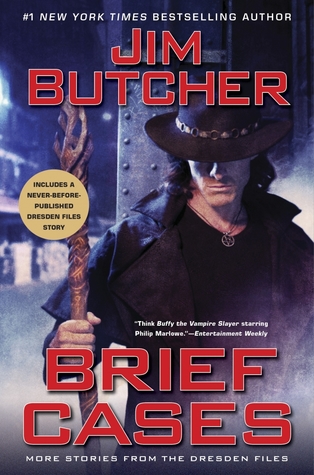
For readers who are not familiar with Jim Butcher’s The Dresden Files series, this collection of short stories offers a sampling of glimpses into a vast urban fantasy world. In Dresden’s universe, faeries and wizards walk among the ordinary, unsuspecting populace, supernatural beings can be either good or evil, and some, such as Bigfoot, simply seek to live their lives in peace.
For fans of the series, these shorts “fill-in” some of the gaps the author feels exist in his chronology complete with commentary as to where they fit in continuity and why they are necessary. Butcher includes stories involving both major and minor characters in his universe, with rarely seen points of view from sundry inhabitants of both the mortal world and the “Nevernever.”
I found myself drawn into this collection very quickly; though they are short stories they are filled with well-developed characters, vivid scenes, deep plotlines, and plenty of action to satisfy most any audience. I award this book 4.5 stars and plan to check out more of the series for myself in the near future.
My husband and I managed to see this over the weekend, no kids in tow! It’s amazing to think it’s been fourteen years since the original was released. What’s even more amazing is how an animated feature film that’s family-friendly can be so relevant to today’s world. Thanks to Matt Watson for sharing this post.
Pixar are about the only studio that can get me to the cinema to see a super hero franchise. When the sequel was first announced, I thought that they were leaving it a little too late in the superhero zeitgeist, but it turns out that the fad never ends. With the core Avengers series not wrapping up until next year, and several franchises in various phases of reboots and reimagines, it appears as though Pixar were right on the money.
Their were children in the theatre, which was weird. I assumed that this franchise was for people who watched the original fourteen years ago, and had spent the time in between not doing much of anything. Except waiting.
It’s only just occurred to me that some of us could’ve had kids of our own in that time. I’m glad I’m not one of them. 80% of the…
Jasmine “Jazz” Bashara is just your typical small-town girl-she works hard to make ends meet, hangs out with friends at the neighborhood watering hole, fights with her devoutly religious father, and occasionally runs afoul of local law enforcement. That is, she’s typical until you take into account the “small town” is actually a colony on the moon, and she augments her work as a courier with running a smuggling operation that is mostly ignored and tolerated by the Artemis government.
As far as smugglers go, Jazz has integrity and a conscience-no weapons, no drugs, nothing overly dangerous for the fragile bubble-domes that support life on the unforgiving surface of the moon. So when she’s approached by wealthy businessman Landvik Trond to sabotage an entire industry whose by-product is life-giving oxygen, she has to think twice. When said businessman is murdered in his own home and Jazz finds the body, she knows she’s in trouble.
Jazz learns from the Artemis governor, Ngugi, that the man sent to kill Trond and herself works for a powerful Earth-side mafia organization with designs on taking over the colony. She then enlists her friends and allies to find a way to stop the takeover bid. However, a glitch in the life support systems leaves Jazz the only person awake and capable of stopping everyone on the moon from being killed. The smuggler with a conscience chooses to risk her life to save the inhabitants of the domes she calls home.
In Artemis author Andy Weir skillfully weaves sci-fi with action, thrills, and gangsters in a book that transcends genre. Parts of the story reminded me of Total Recall, particularly the oxygen drought and the journeys on the surface in EVA suits, but the story of Jazz, told in first person, is unique and special in so many ways.
The complex central character is both an anti-hero and a heroine in her own right. She is self-involved and openly runs an illegal operation, but despite that she is a good, moral person who will go to any lengths to protect her family and friends.
This book was a choice for my local book club and I had not seen so much as a summary of the action before I began reading. I will say the novel was completely different than my expectations, but I was hooked from the very beginning. I rate this book a full five stars and would recommend it to anyone who is a fan of empowered female characters, sci-fi or thriller stories.
Dorothy said it best when she repeated the mantra, “There’s no place like home.” I could ask one hundred people and probably get one hundred different definitions of the word “home.”
For some the term invokes images of a physical building, for others it’s a person or group of people, and for still others the word implies a concept. Most of us equate “home” with feelings of warmth, safety, and belonging. We all desire a safe place, where we will not be judged for being ourselves, where we can find acceptance and love.
Sometimes home is not so much a location that we go or occupy, but an ideal, a dream of what can be, or what we aspire to. What we call “home” in our heads or hearts could be a memory from childhood, even if the physical site no longer exists. (If your home fits into this category, then you can say you carry it with you wherever you go.)
Over the past few months, I’ve spent a lot of time working on projects around my personal nest. I’ve decluttered, painted, planted, and visited every home improvement store within a fifty mile radius. I’ve helped my husband assemble a video doorbell system, and watched technicians install new appliances. Why all the fuss? For the sole purpose of breathing fresh life into the space my family and I have called ours for fourteen years.
I work from my home, so it’s even more important to me that the place I live is comfortable, attractive, and neat. Separating my work and other activities is not always possible, but at least I can create a space where I don’t mind spending my time.
At the end of a long day, I am more than ready for some quiet time to unwind, to read a book or watch TV with my husband, and just enjoy being home. Does this make me a homebody? I don’t really mind the label. As nice as it can be sometimes to get out, or go away, I always look forward to returning to the place we call home.
Good news for all the bookworms out there! Indulging in our favorite hobby is actually good for you. Check out this post from Janice at jemsbooks.wordpress.com
This is a post from 2017 that I wanted to share again. It is extremely important to know about the value of reading not only for your mind but for your general health. Read on…..
When we read a book it is like traveling around the world, or to outer space, or to a land that only exists in a writer’s mind, or into the mind of a killer, or into the animal kingdom, or on a visit to an exotic location, or into the world of faeries or science fiction.
We can go wherever we choose to go! All we need to do is pick up a book about whatever interests us. There are millions of books available online, in book stores or libraries to choose from. We can escape for as long as we choose to read.
When Harvard professor Robert Langdon accepts an invitation from his friend and former student Edmond Kirsch, technology guru and futurist, to attend an announcement at Spain’s Guggenheim museum, he has no idea what to expect. He is aware of Kirsch’s flair for drama and near-prophetic insight into the trends of scientific breakthroughs, but that hardly prepares him for the multi-media presentation Kirsch is about to unveil. Langdon doesn’t expect his former student to claim to have once and for all answered the most basic questions for humanity-where do we come from? Where are we going? He certainly doesn’t expect Kirsch to be murdered in front of a live audience, before he can answer those questions.
Robert Langdon has had his share of adventures in the four previous novels from author Dan Brown, but none are quite like this. Once again, Langdon’s knowledge of symbolism and art history allow him to puzzle through clues and hidden meanings most would overlook, as he seeks to fulfill Kirsch’s last wish and release his presentation online to a swelling audience that includes religious and anti-religion fanatics, scientists and conspiracy theorists.
Accompanied by Ambra Vidal, the museum director who has ties to the royal palace of Spain, Langdon uses the clues left behind by Kirsch and a remarkable AI the technologist developed named Winston to uncover the code needed to activate the presentation and perhaps change the world. Unfortunately, Kirsch’s assassin is still at large and has new targets-Langdon himself and Vidal.
Meanwhile, insiders in the royal palace discover a link between Kirsch’s murder and an anonymous call from the palace just before the event. Did someone inside the palace order Kirsch silenced? Suspects include the crown prince, who is revealed to be Ambra’s fiancée, and Bishop Valdespino, the ailing king’s oldest friend. Or are they all the innocent victims of a conspiracy perpetuated by the rival Palmerian church, where the assassin is a member?
As always, Brown delivers a story that draws deeply from the art, history, and scenery of its locations. He spins tales involving codes and intrigues from the ages, and weaves them seamlessly into plots full of action and mystery. Origin, though, adds another element from its doomed character, Kirsch, that of science fiction. This tale includes a surprising supporting character in the form of Winston, the next-generation computer AI that possesses the ability to act and influence the world, and take creative license with his creator’s instructions.
I will say this is the first time I’ve been able to pick up on some of the twists in a Dan Brown novel before they were revealed, but I was not able to do so until almost the end of the massive 456 page book. The scope of the story, the believability of the plot, and the epic journey still rate this book 5 stars and I would recommend it not only to current fans of Brown, but anyone interested in mysteries, sci-fi, and action/adventure stories.
One of my earliest reminisces of this May holiday, before I even understood its real meaning, is of riding in the back of a pickup truck with my family down winding country roads to reach the old family cemeteries. Once there, we would disembark and make our way up a hilly path, to a fenced-in area of carefully tended lawn bordered by shady trees. Laden with plastic tulips and daisies, we would seek the markers for ancestors whose names I only recognized from stories, and place our bounty in careful clusters and rows.
This is one way my family honored those who had gone before, ancestors whose faces were etched in the memories of the older generation, and introduced to the children by way of books and boxes of old sepia-toned photos. My parents had relatives who had never come home from war, and others who didn’t survive childhood. There were aunts, uncles, siblings, and generations of grandparents, grouped in couples and families; bound forever to memory by icons of marble and metal, of small flags and larger angels, of loving epitaphs and last words.
Of course, there are plenty of other ways to honor the dead. Each culture across the globe has developed its own customs of remembrance; for instance, the Day of the Dead celebrated by families of Mexico and the southwestern part of the United States, and All Saint’s Day and All Soul’s Day, Catholic holidays celebrated in many countries.
There are books and television channels devoted to history and software that traces genealogies as far back as written records exist. What all of these have in common is that they are a way to remember our roots, and those who have given their lives for us, that we may continue to live and hopefully honor them in the paths we choose.
Today is the official Memorial Day celebrated in the United States. Today, especially, we celebrate the lives of our family members who are no longer with us, and the veterans who gave their lives in service to our nation. Today we honor their sacrifices, their accomplishments, and their legacy. However and whenever you choose to honor, celebrate, and mourn lost family and our national heroes, let today be a day of commemoration, and celebration.
Those readers who’ve followed this blog for some time know that I occasionally write a piece about strong female characters, the kind that star in action movies or solve crimes or just go toe-to-toe with their male counterparts. Today, I decided to take a look at the other side of things, those strong female anti-heroes. These ladies definitely stand their ground; they just do so for their own gain, or on the side of evil. In no particular order:
The Borg Queen,Star Trek: First Contact. This ruler of a cyborg race threatening the galaxy with “assimilation” routinely gives orders that overrun planets and turns sentient beings into mindless drones, but she still understands emotions well enough to sway both Captain Picard and Data with her feminine wiles, pitting them against each other in a deadly conflict that could mean the end of the Enterprise and its crew.
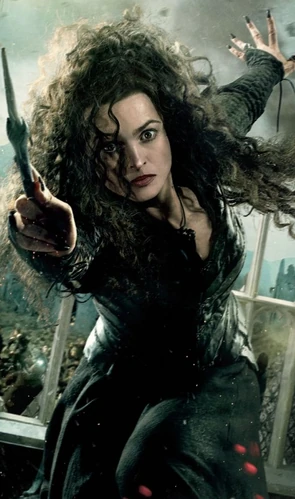
Bellatrix Lestrange, Harry Potter and the Order of the Phoenix, et al. One of Lord Voldemort’s most sadistic followers, Bellatrix is an evil unto herself. She tortured Neville Longbottom’s parents into insanity, a fact she can’t help rub in his face, and tried to kill Harry before sending her own cousin into the Veil of Death. She has no scruples, and even a stay in the worst prison of the wizard world can’t dim her thirst for mayhem.
There have numerous retellings of Snow White, but no Queen is more evil than the version portrayed by Charlize Theron in Snow White and the Huntsman. Queen Ravenna, in true fairy-tale fashion, drains the youth from young women in her kingdom to maintain her own youth and beauty. She murders the king on their wedding night, and imprisons his daughter in a tower. She then lures the huntsman into doing her bidding with promises to raise the dead, and aspires to eat Snow White’s heart to become immortal.
Harley Quinn, Suicide Squad. This completely certifiable femme fatale is the Bonnie to The Joker’s Clyde. A former psychiatrist, she gives up sanity and morality for the sake of the man she calls “puddin.” She is the ultimate crime moll whose weapon of choice is a baseball bat, and has no qualms about using it on anyone who gets in her way. She is violent, dangerous, and perfectly capable of smiling at someone while she kills them where they stand. Don’t get in her way.
Delores Umbridge, a politician who makes her debut in Harry Potter and the Order of the Phoenix. This witch, who dresses in all pink and decorates her office with plates covered with cute kittens, has an evil smile and a giggle that would not be out of place from a villain in a horror movie. She pretends to be a friendly, mild-mannered government servant until someone disagrees with her, or her beloved minister, then anything goes, from illegal artifacts to outright torture and attempted murder.
Hela, Thor: Ragnarock. The god of thunder’s long-lost sister wants revenge for her imprisonment, and to take her father’s throne. When Thor and the citizens of Asgard disagree, she starts killing off the population, and resurrects the dead warriors of Asgard. She puts her little brother in his place by destroying Thor’s hammer and putting out his eye. Why? Because she carries a grudge against their deceased father and she has to show little brother that she is more powerful and deserves the crown more than he.
What all these women have in common is that they have chosen to a life filled with violence, with evil, with violence. They may be lacking in morals and even humanity, but they prove that they are just as capable and strong as their male counterparts.
In his Amazon Prime series, Aaron Mahnke offers an overview of the “lore” from numerous cultures created by our ancestors in an attempt to explain the unknown workings of the world around them. For example; how did a deadly disease contribute to a belief in the existence of vampires? What geological features as said to be the home of fairies?
Now the writer, producer, and narrator of the series Lore has released an anthology titled The World of Lore: Monstrous Creatures, which includes some of the most interesting encounters from the popular show as well as a wealth of additional stories and background information about the evolution of the myths, folklore, and campfire tales of “things that go bump in the night.”
The author uses historical accounts and descriptions of known “sites” of supernatural and unexplained phenomena to describe how a lack of scientific knowledge and fear of the unknown culminated in a belief in numerous supernatural creatures and phenomena. Then he shares examples of the tales of happenings in a “story-telling” manner consistent with the scripts of the television series.
I found the scholarly portion of the book to be very informative but a little dry, despite attempts by Mahnke to inject humor and current events into his explanations of the supernatural. By comparison, his accounts of the “events” read like very engaging short stories of horror and the paranormal.
After reading a large portion of the book, I decided I needed to watch some of the episodes of the show for comparison purposes. I found that the podcast featured some of the same stories in the book, heavily dramatized and enacted, but seemed to focus more on one particular example instead of the multiples given in the manuscript. While both were interesting, the dramatization of the show drew me in much more quickly than the volume, if only because the length of the episode was longer than each encounter narrated in the book.
Still, I found the book interesting enough to give it four stars and would recommend it to anyone who wants not only to get a chill out of a story of the paranormal, but also an understanding of why the story could make the reader feel fear in the first place.